Beamer Example

28 April, 2008 by Mathew

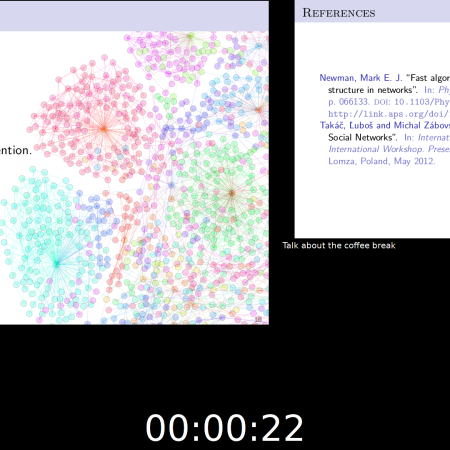
Below is a short example of how to make a presentation using the Beamer Class for LaTeX. I’ve been using this for about 2 years and only just became competent, but if you are less likely to leave things to the last minute than me - which you most likely are - you can probably have success much sooner.


\documentclass{beamer}
\mode
{
\usetheme{Pittsburgh}
\setbeamercovered{transparent}
}

\title[Short Title]{Longer Title}
\author[Another]{A. N. Other}
\institute[University of Somewhere] % (optional, but mostly needed)
{
Department of This and That\\
University of Somewhere
}

\subject{Example Presentation using Latex Beamer Class}

\begin{document}

\begin{frame}
\titlepage
\end{frame}

\begin{frame}
\frametitle{Contents}
\tableofcontents
% You might wish to add the option [pausesections]
\end{frame}

\section{Example Section}

\subsection{Example subsection}
\begin{frame}
\frametitle{Another page title}
Some unstructured content
\end{frame}

\end{document}

For a longer example, including examples of inclusion of images, download this gzipped tape archive file. I like quite a simple layout for presentations, either some text of an image which takes most of the screen up.

Dividing a line

25 April, 2008 by Mathew

Here is a solution I found for dividing a line in 3 (or any other number of divisions) using a compass and a straight edge.

First construct a line at right angles to the line you want to divide, use the compass to make the line the same length as the first line. Then use the compass to make 2 marks along the second line, and one mark along the first line. Drawing a random circle off to the right is completely optional.
[Diagram showing second step]

Draw a line to construct a right triangle with the ratio 3:1 between it’s two sides, then construct a line perpendicular to the hypotenuse by drawing two circles centered on the line.
[Diagram showing third step]

Make another perpendicular line which is perpendicular to the previous one, but also passes through the end of second line we drew. This line will divide the original line, passing through at a third of the distance along.
[Diagram showing penultimate step]

Either repeat steps to divide the remaining part, set compass to the length of 1/3 we know have found or bisect the remaining portion of line in this case.

This a much easier problem than dividing an angle into 3 equal parts.

Honest Spam

21 April, 2008 by Mathew

I just received the most honest spam, subject line “[[utf-8] Phishing] - You’ve received a question about eBay item: @NEW designer DKNY latest watch with diamond spring 08@ (110243158561)“.

Either this spam is filtered and marked as phishing, but still allowed into my inbox, which I don’t understand.

Or the spammers are really using ‘Phishing’ in their subject line… maybe this saves time in finding people to dupe.

Good News for Ugly men and Beautiful women.

20 April, 2008 by Mathew

A new study shows that physically less attractive men make better partners. In couples were the man was less attractive than the woman, both partners were more supportive to the another.

Full story reported at Yahoo news.

I think these results interested and in need of further experimental validation.

Example script: Making thumbnails

3 April, 2008 by Mathew

Here is an example script to make jpg thumbnail images from all the jpgs in a directory.

It relies on having the linux ‘convert’ package installed on the machine.


#/bin/sh

for img in `ls *.jpg`
do
convert -sample 25%x25% $img thumb-$img
done

My Canon A75: E8 error

24 March, 2008 by Mathew

I bought this compact camera late in 2005, so i’m probably fortunate that it has lasted till now reading complaints of the similar failure of other peoples cameras.

a75

I bought this camera for around 100 pounds from E-Buyer. The Powershots allow quite a lot of choice of settings compared to other compact cameras. I’ve had quite good use of it, and it’s been resistant to my mishandling. I damaged the closing mechanism to protect the lens by carrying the camera in a pocket whilst cycling soon after I bought it, but fixed that using some tweezers. I’ve probably dropped it a few times and it has survived being carried in various bags, although the outer is actually in pretty good condition, not many scratches.

Anyway after taking some pictures recently the camera just packed up working. This seems to be associated with the camera running out of battery whilst retracting the lens, although I have probably done this many times since buying the camera.

Searching the internet for “e18 canon powershot” I found this is a common error in many Canon cameras.

This is what my camera looks like now:
My Canon A75

I currently have the camera sat on my desk with no battery in, hoping it’s going to forget about this error and start working again. Otherwise it looks like i’m in the market for a new compact camera.

This was the last picture I took: Angry Sheep

Tempering of Martensite

20 March, 2008 by Mathew

Stage 1
upto - 250 C - precipitation of eta-carbide, partial loss of tetragonality of martensite.
Steels above 0.25 wt% carbon precipitate hexagonal close-packed eta-carbide within the supersaturated martensite until 0.25 wt% carbon level is reached, martensite preserves some tetragonality. The orientation relationship between the laths or rodlets and the cube planes of the matrix was first described by Jack [1].

Stage 2
200-300 C - decomposition of retained austenite.

Stage 3
200-350 C - replacement of eta-iron carbide by cemeneite,; martensite loses tetragonality

Stage 4
350 C - cementite coarsens and speroidizes, recrystallisation of ferrite.

[1] Steels 2nd Ed, Honeycombe and Bhadeshia, Edward Arnold, 1981, p172.

Images of Tungsten Filament Lamps

5 March, 2008 by Mathew

Here are some images of various failed tungsten filament lamps. For more details see the report linked at the bottom of the article, this includes captions and discussion.

filaments002.jpg

filaments003.jpg

filaments004.jpg

filaments005.jpg

filaments006.jpg

These micrographs were given to me as part of a project which made up part of my undergraduate degree: Case Study on Tungsten Filament Lamps. In the report it discusses the manufacture of Tungsten filament lamps, some of the physics involved and discusses some alternative light sources that can be used.

The project was taught with great enthusiasm by Prof. G. W. Greenwood.

Biomimetic materials

3 March, 2008 by Mathew

Biomimetic materials are an attempt to improve technology by looking at nature. It’s true that nature has come up with some of the strongest and lightest materials known. Natural materials often have an optimised design e.g. tree trunks, hedgehog spines, sea shells, spiders webs all of which have inspired people to attempt to replicate their performance.

biomat007.jpg
The structure of wood has inspired some composite designs to attempt to improve toughness

One major advantage of natural materials are made at ambient temperatures from water based solutions. This suggests it should be possible to make major energy savings if it is possible to use the materials directly or to copy natures manufacturing techniques techniques. There has also been a parallel interest to develop materials for use as electronic or optical devices which ’self-assemble’ fine scale microstructures, to enable the production of materials with novel properties.

biomat002.jpg

The table above illustrates that wood can exhibit better specific moduli than other common engineering materials. This is demonstrated by the fact that wood is still used extensively in construction, especially in smaller buildings such as homes. In the UK although most buildings are brick rather than wood as in some other counties the structure to support the roof and floors is usually made from wood.

One omission from the table is that the specific moduli can be improved by changing the shape of engineering structures, a hollow tube made from steel or aluminium has a much superior specific stiffness than a solid rod (e.g. as used in bicycle frames). (i.e. engineers often have already found the same solutions as nature exhibits).

biomat003.jpg
Porcupine and hedgehogs have developed various solutions for quill structures.

biomat006.jpg
Honeycombe structures are a common solution for applications that need to be light and stiff.

The slides here are from a presention I made as an undergraduate which can be downloaded in full here:
Biomimetic materials presentation

Applying for a Fellow

28 February, 2008 by Mathew

I’ve yet to be invited to be a fellow/junior research fellow at any of the colleges here… apparently they expect people to apply to them. To encourage them i’ve produced an application form for any colleges that would like me to join. Simply complete the form and return it to me and I will consider you in due course. The deadline for submission is June of each year.

If you are successful in this round, a series of interviews will be conducted, and each college should be prepared to supply a list of references.

Making Steel from Plastic

22 February, 2008 by Mathew

Another break through by researchers in Australia.

Final Preparation techniques for TEM

22 February, 2008 by Mathew
Material Technique Details Reference
Fe-Si, S.S. EW 60% H3PO4, 40% H2SO4, 9V Tomlinson 1958
Many Steels E 96% CH3COOH, 4% H2O + 200 g/l CrO3. Stir at 65°C for 1 hr. Cool use at » 10 V. Rinse in alcohol, dip in acetic acid before replacing in electrolyte. Glenn and Raley 1963
Fe, mild steel EH 88% CH3COOH, 12% H2O + 170 g/l CrO3, 20 V Briers et al. 1964
S.S. EH 5% HClO4, 95% CH3COOH + 20 g/l CrO3 + 10 g/l NiCl2, 50-80V. Stir. Briers et al. 1964
Many Steels EIJ 100 g Na2CrO4 per 500 ml CH3COOH, 30-35 V Shoone and Fischione 1966, Glenn and Schoone 1964
Many Steels E H3PO4 + excess CrO3, stand 1 day before using, Low Voltage. Keown 1970
Fe and S.S. Disapol Disapol A2 Phillips and Hugo 1960
Fe-33 Ni EB 5% HClO4, 95% CH3COOH, 40V Krauss 1963
Fe, mild steel Figure of 8 10% HClO4, 90% CH3COOH Brandon and Nutting 1959a and b
Mild Steel EP 95% CH3COOH, 5% H2O + 400 g/l CrO3, 1-3V Ginn and Brown 1965
Bainitic or martensitic Steels EP 95% (CH3CO)2O, 5% HClO4 Irani and Jones 1966
S.S. EJ Dimple: 48% H3PO4, 32% H2SO4, 20% H2O. Final: 54% H3PO4, 36% H2SO4, 10% C2H5OH or H2O Rowcliffe 1966
Fe-Ti EIJ Dimple: 95% CH3COOH, 5% HClO4, 12 V, 20°C. Final: 60% CH3OH, 34% n-butanol, 6% HClO4, 15 V, -50°C Rack and Cohen 1970
Fe-17 Cr-10 Ni EP 70% C2H5OH, 20% Glycerol 10% HClO4, -10°C, 5-20 V Raty et al. 1966
Fe-Si E Single crystals. 80% H3PO4, 13% CrO3, 7% H2O, 8V Gemperle 1963
Fe-Si High purity material, Disapol AC-1 (AC-2 and D-” also suitable) Walter and Koch 1962
Fe-Ni EB 6% H2SO4, 94% H3PO4 + 100 g/l CrO3, 60°C, 0.33 A/cm2 Hammond and Ansell 1964
Fe-Mn E 70% H3PO4, 30% H2O + 300 g/l CrO3, 65°C. 6V Roberts 1964
Fe U Diamond knife Phillips 1967
Magnetic iron oxides Ion 6kV, argon ions Schmidt et al. 1970
Fe3O4 CJ 80% H2PO4, 20% H2O, 120°C Wicks 1968

B Bollmann technique

C Chemical Polish

E Electropolish

H PTFE holder

I Immersed (of jets)

Ion Ion Beam thinning

J Jet technique

U Ultramicrotomy

W Window technique

Acetic acid CH3COOH

Acetic anhydride (CH3CO)2O

Cadmium hydroxide Cd(OH)2

Chromium trioxide CrO3

Ethanol C2H5OH

Hydrochloric acid HCl

Hydrofluoric acid HF

Hydrogen peroxide H2O2

Methanol CH3OH

Nitric acid HNO3

Ortho-phosphoric acid H3PO4

Perchloric acid HClO4

Potassium cyanide KCN

Potassium ferrocyanide K4Fe(CN)6

Sodium hypochlorite NaOCl

Sodium hydroxide NaOH

Sulphuric acid H2SO4

Water H2O

Data from ‘Practical Methods in Electron microscopy, Vol 1, P. J. Goodhew, Ed: Audrey M. Glauert, 1972, North-Holland/ American Elsevier.

Table and Chemical names generated from Latex using ‘tth’ command.

Self Healing Rubber

21 February, 2008 by Mathew

A self healing material has been developed, rather than having large molecules cross-linked with covalent bonds as in vulcanized rubber, this polymer is based upon smaller molecules which are ‘cross-linked’ by weaker ‘hydrogen bonding’. After the band is cut the two halves can be placed back together, after around 1 hour the original strength is recovered - presumably the molecules are fairly mobile and some diffusion occurs to remove the evidence of the breakage.

This work new material has been reported in ‘Nature’.

Writing micrometer in LaTeX

10 February, 2008 by Mathew

Simply using math mode in latex to generate the SI micro- prefix isn’t correct since this will produce an italic symbol.

One way to properly write micrometer is by using the SIunits package, this may well be included as a package with the latex on your computer. An example latex document to achieve this is demonstrated here:


\documentclass{article}
\usepackage[mediumspace,mediumqspace,Grey,squaren]{SIunits}

\begin{document}
\unit{100}{\micro\meter}
\end{document}

There are many options specified for the package SIunits in the example above, the first two can be used to control the use of white space, Grey and squaren can be specified to avoid conflicts with other packages you may be using.

Writing Widmanstaetten

9 February, 2008 by Mathew

Professor Bhadeshia has some details about how to write Widmanstaetten on a webpage here.

In html the a umlaut character can be produced as below, you can find tables to look up various characters, such as this one, the ultimate authority on this being the w3c or whatever happens to work in your browser depending on your perspective.

ä — in html & # 2 2 8 ;

I’m naively hoping that is valid html, it seems to work in my browser and be allowed by wordpress. I did notice that the embedded videos from youtube are not standard html, at least not xml 1.0 compliant.

Anyway, it’s also fairly easy to produce this character in latex, it doesn’t even need the inclusion of any special packages, this simple example seems to work fine.

Example latex document using the a umlaut.

\documentclass[]{article}
\begin{document}
Widmanst\”atten
\end{document}

Something americans need to know… about RON PAUL

4 February, 2008 by Mathew

If you are American and you believe your country should be for the American people, you should really check out RON PAUL.

Being that rarest of thing, an Honest Politician, seemingly an oxymoron, an enigma wrapped in contradiction… I think it only works because the Truth is so needed, and in such short supply.

Ron Paul may be the only candidate who is interested in saving your country, and has spent the time thinking about what really needs to be done.

He’s a true conservative, and truly compassionate. He knows you can’t afford to continue the needless war in Iraq, and you won’t be able to pay for the domestic spending promises either without changing course now.

A truly passionate and educated man, it’s time to hear his message.

You know I feel embarrassed to believe a politician can be a good person. Look at his voting record, he really votes as he believes the constitution dictates, because he knows the rule of law is paramount to maintain any nation. Change the laws if they are anachronistic, but you can’t ignore them!

Liquid Nitrogen Explosion

31 January, 2008 by Mathew

Example of one of the dangers of using cyrogenic/ compressed gases, rapid expansion caused by the boiling of nitrogen releases a huge amount of energy.

US Presidential candidates court over-weight voters

29 January, 2008 by Mathew

Worth watching this special report by the Onion News Network on the lengths the presidential candidates are prepared to go to in garnering votes.

[Can't embed movie here]

Briggs-Rauscher reaction

23 January, 2008 by Mathew

The Briggs-Rauscher reaction is an example of an oscillating reaction. Two competing reactions the rate of which depend upon the concentration of the solution in such a way to create an instability. Of course there is an explanation at wikipedia, also the Chemistry department of the University of Leeds have an explanation with more details of the chemical reactions involved.

MIT OpenCourseWare

23 January, 2008 by Mathew

I was impressed to see the systematic release of coursework into the public domain by MIT. A large amount of course material, lecture notes, exam questions and answers has been made available with a creative commons license and it available to take and modify for non-commercial uses [please check license issues yourself if you intend to do this]. The material covers many subject areas and a total of 1800 courses.

MIT OpenCourseWare